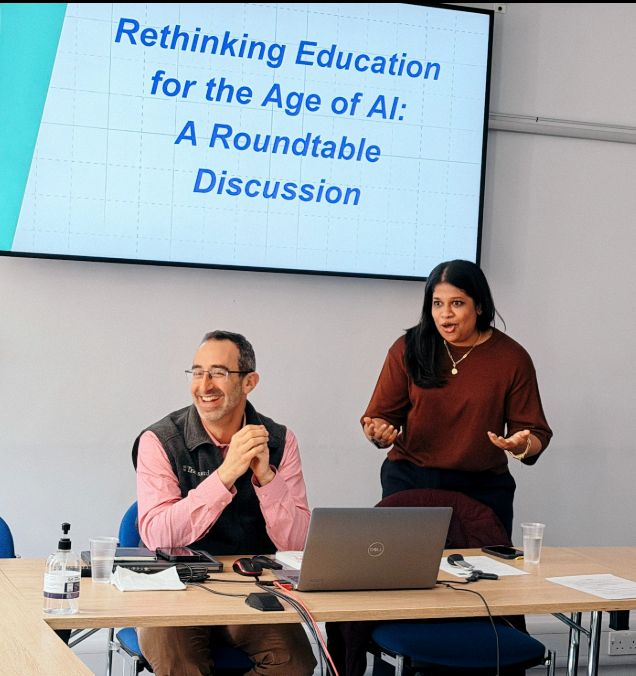
On 22 April, Transcend and Global Schools Forum convened a roundtable at the Education House, a side event at the Skoll World Forum to ask a question that often gets lost in the rush to adopt new tools: in the age of AI, what is education actually for? Around the table sat school founders, system leaders, funders, researchers, and field-builders working across Africa, Asia, Latin America, Europe, and the United States.
From the start, participants pushed past the familiar framing of "risks vs. opportunities." AI, several noted, has not introduced new questions about the purpose of schooling so much as intensified the ones we have been avoiding. If a model can summarize, draft, code, and tutor in seconds, then "covering the curriculum" is no longer a serious aim. The deeper question is what kind of human beings, and what kind of societies, our schools are meant to cultivate.
Four themes emerged from the discussion
First, AI is forcing us to confront the aims of today’s systems of
education.
Across very different contexts — from low-fee schools in South Asia and East
Africa to public districts in North America — leaders described the same
dissonance. Industrial-era, exam-driven systems were built to sort and standardize.
They were not built to develop young people's full humanity. AI has made that
mismatch impossible to ignore.
Second, foundational skills remain essential, but they are no longer
enough.
Literacy, numeracy, scientific reasoning, and clear communication remain
non-negotiable. On top of those, participants kept returning to a wider set of
capacities: agency, creativity, inquiry, ethical judgement, adaptability, and
critical thinking. These are what make the foundations usable in a world where
information is cheap and judgement is not.
Third, motivation and learner agency are emerging as the central
educational challenge. Several participants observed that many systems still
condition young people to become passive consumers of content rather than
active creators of meaning. AI can deepen that pattern — or interrupt it. Used
well, it can support more personalized, self-directed, and relevant learning
that strengthens intrinsic motivation. Used poorly, it can hollow out the very
thinking we are trying to develop.
"Will we raise generations of people who can use these extraordinary
tools to create, or are they only going to consume?"
Fourth, technology cannot replace human relationships or the craft of
teaching.
There was strong consensus that AI is a tool, not a solution. Personalization,
accessibility, and adaptive support are real gains. But meaningful learning
still depends on trusted relationships, thoughtful pedagogy, mentorship, and
the professional judgement of educators — especially when we partner with
communities that have been historically under-resourced. As one participant put
it, most of what truly matters in education is not AI-driven at all. It is
rooted in human connection.
A
through-line of the conversation was a tension that any honest reform agenda
has to face. Caregivers and young people across our communities continue to
rely on educational credentials as pathways to dignity, stability, and social
mobility. At the same time, the systems that issue those credentials are
increasingly misaligned with both human flourishing and economic reality.
Reform that ignores either side of that tension — the lived stakes of
credentials, or the inadequacy of what they currently signal — will not hold.
This
is where AI gets interesting. It is not, on its own, a reform strategy. But it
is a forcing function. It exposes which parts of schooling were always about
sorting rather than learning, and it opens space to redesign learning
environments toward experiences that are more human-centered, rigorous,
relevant, customized, and agentic.
Global
Schools Forum and Transcend both entered the room with a shared conviction: the
goal is not to use AI to optimize an outdated model, but to use this moment to
redesign learning itself. That means broader definitions of student success
that include academic foundations alongside the human, adaptive, and technical
capacities this era demands. It means partnering with communities — young
people, caregivers, educators — as co-creators of what comes next, especially
in contexts the global education conversation too often overlooks. And it means
greater coherence and imagination in how systems are designed, funded, and held
accountable.
"Can this technology help us become more fully human?"
That
question, raised late in the discussion, captures the spirit of the room. The
work ahead is not primarily technical. It is about clarity of purpose, courage
to redesign, and the discipline to keep human relationships at the center even
as our tools grow more powerful.
What's next
Coming
out of the roundtable, we see two concrete ways to keep this conversation
moving — and we invite readers to join us in either of them:
A shared learning agenda. Transcend and Global Schools Forum will co-develop a small
set of questions worth pursuing together across our networks: How do schools
redesign for agency without sacrificing rigor? What does responsible AI
integration look like in low-resource settings? How do credentials evolve in
step with broader definitions of success? We will share early framing later
this year and welcome partners who want to learn alongside us.
An open invitation. If your organization is wrestling with these questions in
practice — redesigning learning environments, piloting AI tools with young
people, rethinking what "success" means in your context — we want to
hear from you. Reach out to either of our teams. The point of this work is not
to converge on one answer, but to build a more honest, ambitious, and connected
conversation about what schooling can become.
Transcend partners with communities to create and spread extraordinary learning for all. Global Schools Forum supports non-state organizations in low- and middle-income countries to innovate, deepen impact, and achieve scale.
Reach out to Jeff or Kavita for further information or for a conversation.