Reflections from my first Davos
This year was my first time attending the World Economic Forum in Davos. I arrived with curiosity, and left with dissonance.
Davos is often described as a gathering of the world’s most powerful people, yet what I encountered felt more complicated and more conflicted: a mix of political leaders, CEOs, philanthropists, social scientists, artists, journalists, public intellectuals, and cultural figures, whose presence signals how influence itself is shifting. I appreciated the invitation for global youth to attend, including Young Global Shapers and Young Global Leaders’ groups. The conversations were not confined to official stages. They unfolded in hallways, cafés, side rooms, and snow-lined streets, where education leaders stood shoulder to shoulder with heads of state, AI executives, climate activists, and media celebrities (picture Matt Damon advocating for the GetBlue initiative).
And all of this occurred amid a deep undercurrent of uncertainty. Many quiet conversations returned to the same unsettling question: Are we entering an era where there is no longer a shared global order, only competing interests, narratives, and power structures?
In that context, Davos itself felt contested. To some, the World Economic Forum represents a form of global “soft power”, a place where narratives, norms, and priorities are shaped, even when formal authority is absent. After all, it was here that Nelson Mandela and F.W. de Klerk met during South Africa’s transition from apartheid. To others, it symbolizes a disconnected elite, gathering at a moment when trust in institutions is eroding and the world feels increasingly fragmented.
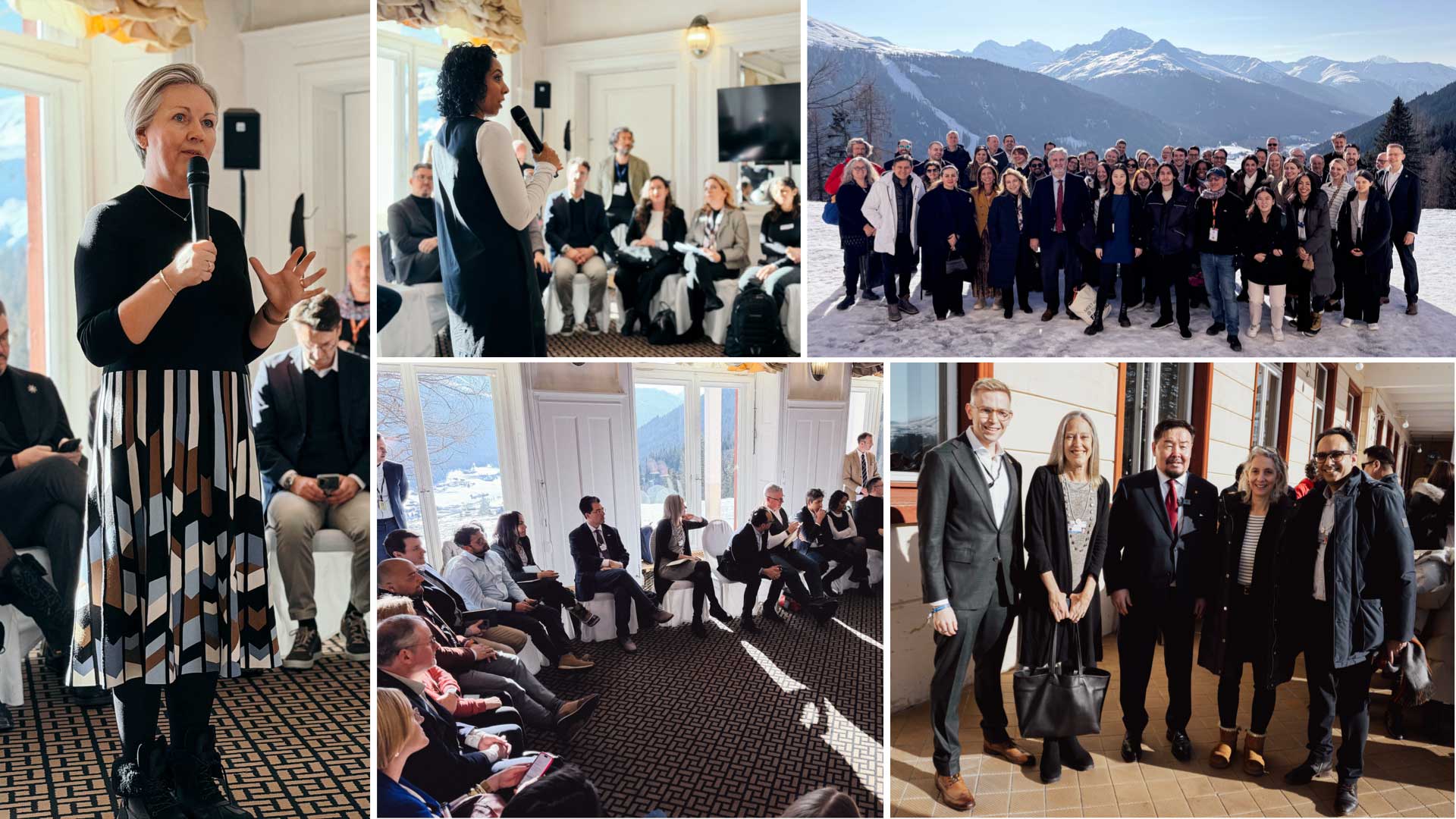
Education was not at the center of the Forum, but it was no longer invisible. Thanks to the leadership of Lasse Leponiemi, Chair of HundrED, it had a visible home in the Education House (hosted at the historic Schatzalp Hotel, where Thomas Mann wrote The Magic Mountain, one of the most iconic literary meditations on time, illness, modernity, and human fragility). The Education House stood alongside spaces like the Human Change House (led by Margarita Louis-Dreyfus) on the main Promenade, where leaders explored how technological, social, and cultural forces are reshaping what it means to be human.
While geopolitics, markets, and artificial intelligence dominated the headlines, they reflected a subtle shift: a growing recognition that human capability, social cohesion, and learning systems may be as strategically important as economic growth itself.
What emerged across those conversations was not simply a call for new skills. It was a deeper reckoning: What does it mean to grow up human in a world increasingly shaped by machines? And what kind of education system will protect that humanity while equipping young people to thrive?
Three themes dominated the week:
- A global race to define the competencies of the future
- A renewed recognition of teachers as the most important change agents
- An urgent debate about technology and childhood—across three escalating levels of risk
From Access to Capability: The New Education Race
For decades, global education goals focused on access: enrollment, completion, and basic literacy. At Davos, the conversation had shifted. The question was no longer how many students are in school, but what they can do when they leave.
Across panels and closed-door sessions, leaders returned to the same realization: Our education systems are preparing students for a world that no longer exists.
The competencies most often cited—creativity, critical thinking, collaboration, ethical reasoning, adaptability, emotional intelligence, and digital fluency—were not new. What has changed is the speed of transformation. With generative AI automating cognitive tasks once reserved for highly educated workers, the half-life of skills is shrinking dramatically.
In this context, education is no longer simply a social good. It is an economic and geopolitical strategy.
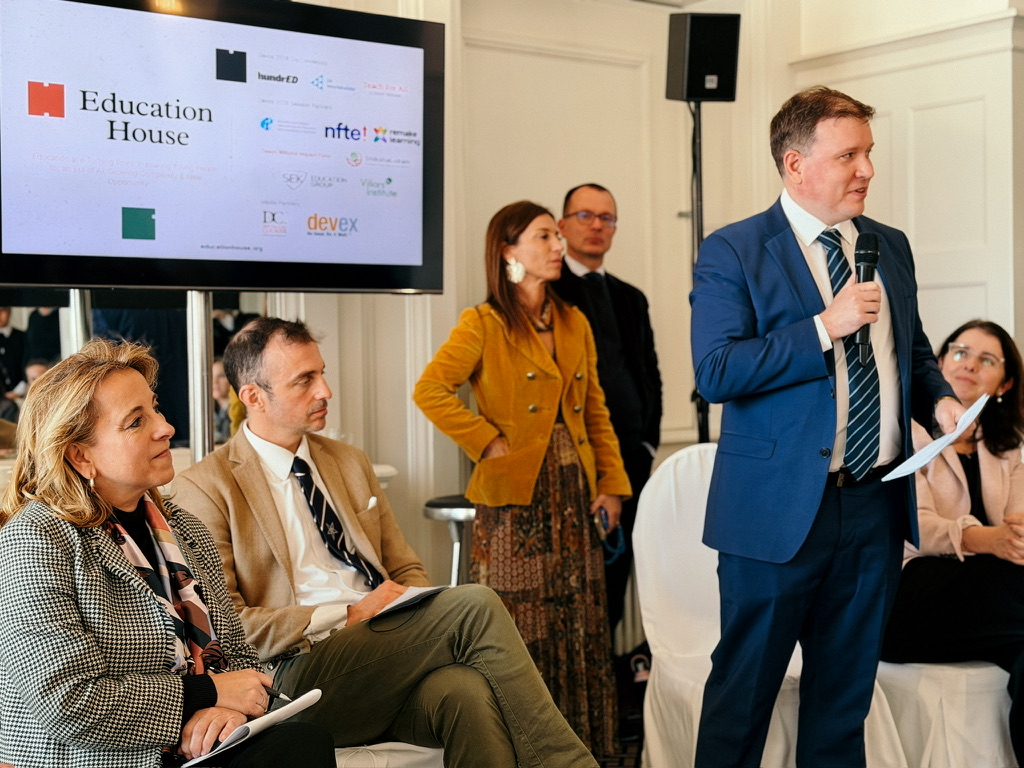
That message was powerfully underscored by the Prime Minister of Mongolia (Yes, the Prime Minister, not the Minister of Education!), who spoke at Education House about education as the foundation of national resilience, workforce competitiveness, and future returns of investment. His remarks were pragmatic, not aspirational: in a world of rapid technological realignment, countries that fail to invest in learning will be structurally disadvantaged.
Finland’s Minister of Education echoed this sentiment, reinforcing why Finland remains a global reference point—not because of test scores alone, but because of its long-term commitment to teachers, equity, and system coherence. The message was unmistakable: education is not a cost. It is critical infrastructure.
Teachers: The Most Underrated Innovation Strategy
If there was one clear consensus across Davos, it was this: technology will not transform education without teachers.
After decades of edtech hype, leaders are finally acknowledging what research has long shown: tools do not change systems; people do. Teachers are not implementation risks; they are the architects of transformation.
Yet the demands placed on educators have never been higher: integrating AI, personalizing learning, supporting student mental health, navigating polarized communities, and preparing young people for jobs that do not yet exist, often without the time, training, or resources to do so. Many highlighted significant teacher shortages globally.
That urgency was underscored by the announcement of a new partnership between Teach For All and Anthropic, signaling how quickly generative AI is moving into the heart of global education, and how essential it will be to center educators as its primary beneficiaries and stewards.
At the Education House, many reframed the challenge not as replacing teachers with technology, but as freeing teachers to do the work only humans can do: mentoring, motivating, building trust, fostering belonging, and cultivating curiosity. The most promising models were not tech-first, but human-centered, where technology augments educators’ insight, reduces administrative burden, and deepens their ability to connect with learners.
Which brings us to the most urgent—and controversial—set of conversations at Davos.
Technology and Childhood: Three Escalating Risks
Across sessions, technology’s role in childhood was discussed at three levels, each more consequential than the last.
1. Devices: The Phone-in-Schools Reckoning
The most visible debate was around smartphones in schools. From Europe to Asia to North America, governments are questioning whether constant access to devices is undermining attention, learning, and wellbeing.
What was striking was the shift in tone. A decade ago, the debate centered on access and digital equity. Today, the focus is on cognitive load, distraction, and dependency.
Many leaders and parent groups described classrooms where students struggle to focus for more than a few minutes without checking their phones—where learning competes with infinite digital stimuli. The issue is not simply distraction; it is the erosion of deep attention, memory formation, and sustained effort, core foundations of learning.
Several countries are experimenting with phone bans or device-free learning environments, not as a rejection of technology, but as a recognition that not all tools belong in all developmental contexts.
2. Social Media and Mental Health: Correlation or Causation?
The second level of concern was social media, particularly its impact on adolescent mental health.
Here, the debate grew more complex. Some leaders pointed to rising rates of anxiety, depression, loneliness, and self-harm that correlate with increased social media use. Others noted that correlation does not equal causation.
But even the skeptics acknowledged this: The scale and intensity of digital social comparison, algorithmic amplification, and attention engineering is unprecedented in human history.
Several countries are now considering age-based restrictions, design regulations, and duty-of-care frameworks for social platforms. The core question is not whether technology can connect—but what kind of connection it is cultivating.
3. AI Companions: The Next Developmental Frontier
The most profound, and least publicly understood, conversation was about AI companions and emotionally responsive systems.
Unlike devices or social media, AI companions are designed not just to engage, but to simulate relationships. They respond, empathize, adapt, and “bond.” For adults, this may feel novel or even therapeutic. For children, it introduces a radical developmental risk.
Human brains are wired through attachment and intimacy. From infancy, neural pathways are shaped by responsive, embodied, emotional interactions with caregivers and peers. When AI systems begin to occupy relational space—especially in moments of loneliness, stress, or identity formation—they may reshape how children learn to connect.
Several experts, myself included, warned that we are approaching a critical threshold where technology no longer merely mediates relationships, it begins to replace them.
In the absence of guardrails or incentives aligned with child development, serious questions are emerging about the need for limits, pauses, or even a moratorium on certain applications of AI, as suggested by Jonathan Haidt.
This is not a speculative future; it is already unfolding. The risk is not only isolation, but the reengineering of social development itself, and, ultimately, a profound threat to our shared humanity.
Education, Childhood, and the Loneliness Crisis
A thread running through every conversation was the growing crisis of loneliness. Children today are more digitally connected, and more socially isolated, than any generation before them: fewer friendships, less unstructured play, fewer intergenerational relationships, and more time alone with screens.
At Davos, leaders began to name what is often invisible: we are designing systems that optimize efficiency, but erode connection. If AI and digital technologies are not grounded in developmental science, we risk accelerating a future where children grow up fluent in machines, but disconnected from people.
Education cannot be neutral at this moment. Schools are becoming one of the last social commons—places where children still learn how to belong, collaborate, and care.
What gives me hope is that this reckoning is finally happening at the highest levels of global leadership. If Davos is a signal of where the world is headed, this year’s message was mixed—but clarifying. We are at an inflection point. Technology is accelerating faster than our social contracts. The work ahead is not only technical or economic; it is relational, ethical, and deeply human.
UNICEF’s message at Davos, “Humanity is a choice”, made clear that the direction we take is not inevitable. It is intentional.
The challenge now is to:
- Design tools and incentives that strengthen, not replace, human bonds
- Build systems that cultivate agency, not dependency
- Protect childhood as a developmental ecosystem, not a market segment
The Education House and Human Change House were not merely venues, they were signals. The future is being negotiated, and education is finally finding its place at the table. The question is no longer whether technology will reshape childhood, but whether we will shape technology to honor what childhood needs most: human love.
Perhaps that, too, is what Davos has always been at its best: a place where the hardest questions surface before the easiest answers exist.
And this year, there are many hard questions.
This post originally appeared on the Edtech Insiders newsletter.